





It emerged earlier this week that the Armenian government allocated last month 3.5 billion drams ($9.2 million) in extra pay for senior staff and other employees of 16 government agencies. Although the government refused to specify the amounts of money paid to each of them, multiple media outlets reported a huge disparity between the bonuses.
Sources told RFE/RL’s Armenian Service that while the ministers, their deputies and department heads received sums comparable to their annual incomes, ordinary civil servants were rewarded with less than one month’s worth of their much smaller salaries.
Justice Minister Srbuhi Galian is the only senior official to have disclosed so far the size of her post-tax bonus: about 7 million drams ($18,400). Galian said on Wednesday that she deserves it because she had earned more in her previous capacity as deputy prosecutor-general. Labor and Social Security Minister Arsen Torosian and Deputy Finance Minister Arman Poghosian refused to give journalists such information, citing privacy grounds.
The lavish yearend payments to Armenian ministers and deputy ministers were made in addition to their monthly bonuses matching their salaries worth 1.5 million and 1 million drams per month respectively. Pashinian caused uproar in 2019 when it emerged that he secretly doubled these officials’ monthly incomes through the bonus scheme.
The latest extra bonuses are proving no less controversial, with opposition figures and civic activists saying that the public funds should have been spent on the country’s urgent needs. Varuzhan Hoktanian, a veteran activist affiliated with Armenia’s leading anti-graft watchdog, denounced them as “political corruption.” He said Pashinian is handing out more cash to his political allies in order to ensure their continued loyalty ahead of this June’s parliamentary elections.
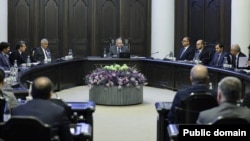
The investigative publication Hetq.am added to the outcry on Wednesday when it revealed that Pashinian himself received 14 million drams ($37,000) in bonuses in the first half of 2025 alone. The prime minister sought to justify the bonuses the next day, saying that they help to restrain the senior officials’ corruption temptations.
“Armenia’s investment environment is changing significantly, and large-scale investments will soon flow into Armenia, and there will be a lot of competition to implement investment projects in Armenia, and our assessment in this regard is that corruption risks could rise significantly, and we need to protect state officials against corruption risks,” he told a news briefing.
Pashinian also claimed that the extra pay is needed to prevent skilled professionals from leaving the government for the private sector.
“This has nothing to do with professionals,” countered Edmon Marukian, an opposition leader formerly allied to Pashinian. “They have not raised the salaries of professionals. They just distributed 3.5 billion drams among themselves.”
Marukian argued that the main beneficiaries of the Christmas bonuses are political appointees mostly affiliated with Pashinian’s Civil Contract party. He condemned the cash handed out to them as a “plunder” of the state budget.
The leadership of the Armenian parliament controlled by Civil Contract similarly caused outrage on social media late last month when it confirmed spending at least 545 million drams ($1.4 million) on yearend bonuses to its members and staffers. Each of the 107 parliament deputies received 3 million drams ($7,850). The net salary of a rank-and-file deputy is roughly 600,000 drams ($1,550) per month.
Opposition lawmakers pledged to donate their bonuses to charities or individual citizens in need. Their pro-government colleagues gave no such promises.
Armenia’s official average monthly wage currently stands at almost 309,000 drams ($810). Most working-age Armenians, including schoolteachers and other public sector employees, earn less than that.
The country’s average pension is just 49,000 drams ($128) per month. Pashinian raised eyebrows recently when he tried to justify his government’s reluctance to increase it.
“If we increase the pension by 11,000 drams or 10,400 drams per month, what will a pensioner do with that money?” he said. “What will they spend it on?”