




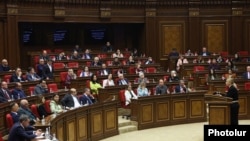
The 107 deputies of the National Assembly are the main beneficiaries of the record allocation. Some of them confirmed on Wednesday reports that they and their colleagues received 3 million drams ($7,850) each. The net salary of a rank-and-file Armenian lawmaker is roughly 600,000 drams ($1,550) per month, which is more than twice the country’s official average monthly wage.
Not surprisingly, the lavish payout caused outrage on social media. The two opposition groups represented in the parliament were quick to make clear that their deputies will again donate their bonuses to charities or individual citizens in need. Their pro-government colleagues gave no such promises.
Responding to the public outcry, the parliament’s leadership issued a cryptic statement explaining and defending the bonuses.
“This decision solves the problem of low salaries in the National Assembly,” it said. “The funds transferred at the end of the year were due to be paid in the first half of 2025.”
The statement also noted that the Armenia’s annual tax revenue has more than doubled since Prime Minister Nikol Pashinian came to power in 2018. Critics countered that there have been no similar rises in the national minimum wage, pensions, poverty benefits or even salaries paid to teachers and other public sector employees.
The country’s average pension currently stands at just 49,000 drams ($128) per month. Pashinian raised eyebrows recently when he tried to justify his government’s failure to increase it this year.
“If we increase the pension by 11,000 drams or 10,400 drams per month, what will a pensioner do [with that money?]” he said.
The amounts and frequency of bonuses paid to civil servants and especially high-ranking government officials and parliamentarians have sharply increased during Pashinian’s rule. The premier has said that these payments discourage corrupt practices in the government. Armenia’s leading anti-corruption watchdog has dismissed this explanation, saying that the lopsided bonuses are primarily aimed at making sure that Pashinian’s political allies and other senior officials stay loyal to him.