



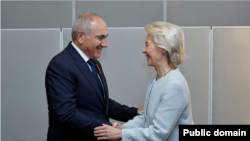
“We are bringing Armenia closer to the EU, while working on a peaceful and prosperous South Caucasus,” she said in a post on X.
Von der Leyen singled out the EU’s decision to temporarily lift import duties on Armenian goods, including agricultural products and beverages that were effectively banned by Russia earlier this year. The so-called Autonomous Trade Measures received the final approval of the EU’s decision-making Council hours later. An EU statement quoted Irish Foreign Minister Helen McEntee as saying that they “will help Armenia’s economy hit by trade restrictions.”
“So: the EU-Armenia partnership is moving fast, forward and stronger than ever,” von der Leyen wrote for her part.
The head of the EU’s executive body again made no mention of the Armenian government’s pursuit of EU membership, which has put it on a collision course with Russia, Armenia’s traditional ally.
Pashinian’s government underscored that policy when it hosted two European summits in May. Moscow responded by imposing the trade embargo and pressuring Yerevan to quickly choose between joining the EU and remaining part of a Russian-led trade bloc. Kremlin spokesman Dmitry Peskov insisted on such a choice on Thursday.

“It is crucial that none of the [Eurasian Economic Union] member states act in contradiction to the rules, regulations, and principles of this integration bloc, which is important for us all,” Peskov told reporters.
Meanwhile, a senior Russian Foreign Ministry official, Vladislav Maslennikov, said that Armenia “will have to wait for a long time” before being admitted to the EU. Speaking to the RIA Novosti news agency, Maslennikov also described the EU’s trade preferences as “largely declarative.” He claimed that Armenian exporters will have trouble replacing Russia with the EU’s “very competitive and regulated market.”
Russia has long been Armenia’s number one trading partner. It accounted for 27.5 percent of the South Caucasus nation’s foreign trade in the first half of this year. Armenian exports to Russia and the EU stood at $1.23 billion and $516 million respectively.
According to government data, Armenia’s overall exports fell by about 16 percent in July and 20 percent in June. The physical volume of Armenian fruits, vegetables and cut flowers shipped abroad shrunk by half in the two-month period.
Russia is in a position to inflict much greater economic pain on Armenia by ending a significant discount on the price of Russian natural gas imported by the country. Russian Energy Minister Sergei Tsivilev warned of such a measure in a letter sent to Yerevan in May.