



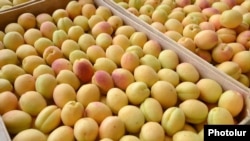
As was the case with other food products essentially banned by it late last month, the Russian agricultural watchdog Rosselkhoznadzor claimed that many of them do not meet phytosanitary requirements of the Eurasian Economic Union (EEU) because of what it called poor oversight by Armenian authorities.
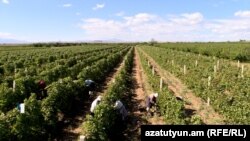
The government agency said that the measure, effective from Tuesday, applies to grapes and stone fruits such as apricots, cherries and peaches. It comes just before the start of apricot and cherry harvesting period in Armenia. Russia has long been a key market for these crops grown by tens of thousands of Armenian farmers.
Many others grow vegetables that have also been exported to Russia in large quantities for many years. Rosselkhoznadzor blocked their imports late week, saying that it has found dangerous “quarantined objects” in many Armenian tomatoes, cucumbers, peppers and greens. Imports of Armenian cut flowers and mineral water were halted earlier in May.
The punitive measures highlight a further deterioration of Russian-Armenian relations that followed the holding of two European summits in Yerevan in early May. Moscow has since been pressuring the Armenian government to choose between continuing to seek membership of the European Union and remaining part of the EEU, a Russian-led trade that guarantees Armenian exporters’ tariff-free access to the Russian market.
On Friday, EEU member Belarus, Kazakhstan and Kyrgyzstan joined Russia in telling Yerevan to make such a choice through a referendum “as soon as possible.” They also implicitly threatened to suspend Armenia’s membership in the bloc. Prime Minister Nikol Pashinian dismissed the demand.
Moscow is ramping up the pressure on Yerevan ahead of the June 7 elections in which Pashinian’s Civil Contract party is challenged by opposition groups pledging to repair Russian-Armenian relations.
According to Armenian government data, Russia accounted for 35.8 percent of Armenia’s foreign trade last year, followed by China (12.3 percent) and the EU (11.7 percent). Armenian exports to Russia totaled almost $3 billion in 2025, compared with $667 million worth of goods exported by Armenian firms to EU member states.
The EU condemned the Russian pressure on Monday. It accused Moscow of trying to “hurt Armenia’s economy” and “influence the outcome” of Sunday’s elections.
“We will continue supporting Armenia to handle such attempts of coercion," EU spokesman Anouar El Anouni said, according to the AFP news agency.
The EU itself was accused by Russia as well as the Armenian opposition of election meddling after deciding earlier this year to send a “hybrid rapid response team” to Yerevan for the ballot. The deployment was requested by Pashinian’s government.