

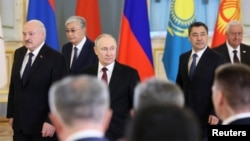
Following two European summits held in Yerevan last week, Putin said that the Armenian government should choose “as soon as possible” between seeking to join the European Union or remaining part of the EEU. He indicated that he will bring up the matter at the EU summit scheduled to take place in Astana, Kazakhstan on May 28-29, less than two weeks before Armenia’s parliamentary elections.
Pashinian effectively dismissed that demand. Citing the ongoing election campaign, he also announced that he will not attend the summit. Lavrov described Pashinian’s decision as “unfortunate.”
"Now, I believe, there will be an optimal chance to discuss the emerging issues arising from the European Union's insistence on drawing Armenia into its orbit, including at the cost of ending the benefits Armenia enjoys through the Eurasian Economic Union,” he told reporters, pointing to the Astana summit.
Pashinian’s government enacted a year ago a law that commits it to striving for Armenia’s accession to the EU. The government reaffirmed that objective when it hosted a European Political Community summit and a separate meeting with the EU’s two top officials on May 4-5. But it remains reluctant to set possible dates for formally applying for EU membership and leaving the EEU.
A senior Russian Foreign Ministry official said on Tuesday that the Armenian leadership cannot continue to “view EEU membership as a temporary measure for the duration of the search for or the process of joining an alternative alliance.” Pashinian insisted on Thursday that his foreign policy is not anti-Russian.
“If I had pursued a policy opposed to the EEU, the EEU would have been paralyzed today because decisions in that bloc are made by consensus and no decision can be made if I am against that decision,” he told journalists.
Critics say that even if Pashinian blocks Russia and other EEU member states from ousting Armenia from the bloc, Moscow will still be in a position to impose crippling economic sanctions on Yerevan. Armenia is heavily dependent on Russia for trade and energy, a fact regularly emphasized by Putin and other Russian officials.