




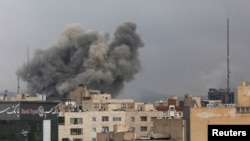
Prime Minister Nikol Pashinian waited for more than 24 before holding an emergency meeting of his Security Council on Sunday in response to the first U.S. and Israeli air strikes against the Islamic Republic that provoked Iranian retaliation. Pashinian and senior members of his Civil Contract party spent Saturday touring the southern Armavir and Ararat provinces in a clear effort to woo local voters ahead of parliamentary elections slated for June 7.
Opposition politicians and other critics accused them of neglecting the war’s potentially adverse impact on Armenia’s security. Justice Minister Srbuhi Galian denied any security risks emanating from the conflict.
“There is no threat to the security of our country,” Galian told reporters, citing the Security Council’s conclusion. “I want to understand why we should deviate from the domestic agenda, and what should have been done to make it clear that the government is concerned, anxious, etc.”
Vahagn Aleksanian, a deputy chairman of Civil Contract, made a similar point and dismissed the opposition criticism. Aleksanian insisted that there might only be economic consequences for the South Caucasus country.
“The government of Armenia is busy with Armenia’s affairs,” he said.
Iran has for decades been one of landlocked Armenia’s two conduits to the outside world, serving as a transit route for part of its foreign trade. Armenian opposition leaders and some analysts say chaos in the Islamic Republic would not only cut off that route but also put Armenia in an even weaker position to deal with what they see as threats to its territorial integrity emanating from Azerbaijan.
Baku has been pressuring Yerevan to open an extraterritorial corridor that would connect Azerbaijan to its Nakhichevan exclave and Turkey through Syunik, the only Armenian region bordering Iran. Tehran is strongly opposed to such a “geopolitical change” in the South Caucasus. The Iranian ambassador in Yerevan, Khalil Shirgholami, said on Monday that this remains a “red line” for his country.
In the months leading up to the war, Iranian officials, voiced serious concern at the Armenian government’s plans to open the transit corridor for Azerbaijan run by the United States. They said the planned Trump Route for International Peace and Prosperity could lead to U.S. security presence along the Armenian-Iranian border. Yerevan sought to allay its fears.