



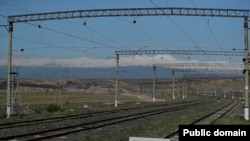
Prime Minister Nikol Pashinian pledged to give the United States exclusive rights to the corridor during his trilateral talks with U.S. President Donald Trump and Azerbaijani President Ilham Aliyev held in Washington in August.
Although the deal is seen by analysts as another blow to Russian presence in Armenia, Russia’s public reaction to it was rather cautious. Moscow said only that the transit arrangement must not be at odds with Armenia’s membership in the Eurasian Economic Union (EEU), a Russian-led trade bloc, and the presence of Russian border guards along the Armenian-Iranian border. The transit corridor to be named after Trump would be adjacent to that border.
Mikhail Kalugin, a senior Russian Foreign Ministry official, also argued that Armenia’s railway network is managed by Russia’s RZhD national rail operator.
“Details of the Armenian-American project are yet to be studied,” Kalugin told the Russia Today news agency. “We are ready to consult with our Armenian partners for discussing both the parameters of the initiative and possible Russian participation.”
“The road will pass, for the most part, through the zone of responsibility of our border guards,” he said. “It is necessary to also take into account the factor of Armenia's membership in the EEU. Obviously, our partners cannot do without Russia.”
The issue is believed to have been on the agenda of Russian Deputy Prime Minister Alexei Overchuk’s visit to Yerevan that took place later in August. Overchuk said ahead of that trip that he will discuss with Armenian leaders “some nuances related primarily to the unblocking of communication routes in the South Caucasus.”
Commenting on Kalugin’s remarks, a deputy speaker of the Armenian parliament, Ruben Rubinian, said that there have been no discussions on possible Russian involvement in what will be called the Trump Route for International Peace and Prosperity (TRIPP).