



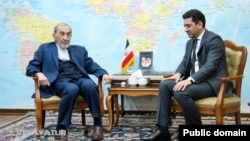
Ali Akbar Velayati said late on Monday that the planned Trump Route for International Peace and Prosperity (TRIPP) would be tantamount to an extraterritorial corridor sought by Baku and strongly opposed by Tehran.
“The so-called Trump plan regarding the Caucasus is no different from the Zangezur Corridor, and the Islamic Republic is absolutely opposed to it,” the Iranian Mehr news agency quoted him as telling Armenia’s ambassador to Iran, Grigor Hakobian.
Velayati said the TRIPP would also lay the groundwork for U.S. or NATO military presence along Armenia’s border with Iran.
“Experience has shown that the Americans first enter sensitive regions with seemingly economic projects, but gradually their presence expands to military and security dimensions," he said, adding that any U.S. presence near Iran’s border has “clear security consequences.”
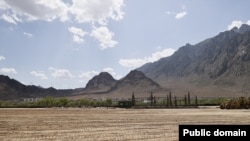
Prime Minister Nikol Pashinian pledged to give the United States exclusive rights to the transit railway, road and possibly energy supply lines during talks with Azerbaijani President Ilham Aliyev hosted by U.S. President Donald Trump at the White House on August 8. The corridor would connect Azerbaijan to its Nakhichevan exclave through Armenia’s strategic Syunik province bordering Iran.
Tehran was quick to express serious concern over the transit arrangement. Velayati warned later in August that it will prevent the opening of the “American corridor” through Armenia “with or without Russia.” Pashinian and other Armenian officials scrambled to address the Iranian concerns, insisting that Armenia will have full control over the TRIPP and ruling out any U.S. military presence along it.
Commenting on Velayati’s latest warning, Ruben Rubinian, an Armenian parliament vice-speaker allied to Pashinian, said: “Our ambassador reiterated to the Iranian side that the TRIPP is a business project that will operate under Armenia's full sovereignty, territorial integrity, jurisdiction and … is not the ‘Zangezur corridor.’”
Rubinian also downplayed the significance of Velayati’s comments, saying the Iranian Foreign Ministry’s position on the issue is more important.
“We are pleased by the fact that the Iranian Foreign Ministry has repeatedly stated that there is really no corridor problem in this matter and that Iran's red lines have also been taken into account,” he told journalists.
Speaking in late September, Iran’s outgoing ambassador to Armenia, Mehdi Sobhani, signaled Tehran’s lingering concerns about the TRIPP. He pointed to a lack of specifics in Armenian officials’ statements on the subject.
Pashinian has made ambiguous statements on the crucial question of the Armenian border crossing procedures that could be put in place for Azerbaijani travelers and cargo. Like Velayati, Armenian opposition leaders say that the TRIPP essentially meets Baku’s demands for unfettered transport links for Nakhichevan and the rest of Azerbaijan. Aliyev and other Azerbaijani leaders have echoed the opposition claims.
Key practical modalities of the transit arrangement remain unknown following a series of negotiations held by Armenian and U.S. officials in recent months. The TRIPP was the main focus of U.S. Under Secretary of State Allison Hooker’s visit to Yerevan last month.
Also visiting the Armenian capital last week was Brigadier General Chris McKinney, a deputy director at the U.S. military’s European Command (EUCOM). According to the U.S. Embassy in Armenia, the purpose of the trip was to “support the outcomes of the August 8 White House Peace Summit.” The embassy did not specify whether those include the TRIPP.
“EUCOM is working closely with the [Armenian] Ministry of Internal Affairs and the Ministry of Defense to advance shared objectives in support of sustained peace, including enhanced cooperation on Chemical, Biological, Radiological, and Nuclear (CBRN) defense and continued military modernization efforts,” it said in a December 10 statement.