

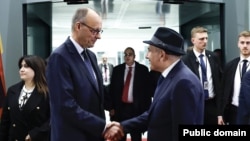
“It has become an almost disturbing norm that elections are attacked by the enemies of democracy,” Merz told a joint news conference. “Russia, in particular, is trying to instill fear in Armenian voters about too close a relationship with Western partners. It is spreading falsehoods about the goals and values of the European Union.”
“Disinformation, sabotage, drones: Russia is trying to destabilize not only Europe but also Armenia through hybrid tactics,” he charged without giving concrete examples.
While not explicitly echoing the claim, Pashinian spoke of “hybrid threats” facing democratic nations. But when pressed by a reporter on the issue, he declined to say whether he sees Russian interference in the Armenian elections due next June. He said only that his government will continue to counter “flows of disinformation” with “active dialogue with our people.”
Last week, the European Union’s foreign and security policy chief, Kaja Kallas, similarly accused Russia of spreading election-related “disinformation” in Armenia. The Russian Foreign Ministry angrily denied the accusation.
“Their statements once again prove that Brussels's only goal in interacting with Yerevan is, in fact, to damage Armenia's relations with Russia,” said the ministry spokeswoman, Maria Zakharova.
Moscow has sought to downplay its heightened tensions with Yerevan in recent months. Russian President Vladimir Putin said in September that Russian-Armenian relations are growing “in all areas.”
Underscoring those tensions, the Armenian government pushed through the parliament this spring a law declaring the “start of a process of Armenia's accession to the European Union.” Pashinian mentioned the law after his talks with Merz.
“In this context, I highly value Germany's support for deepening the Armenia-EU partnership, expecting continued political support on our difficult and lengthy path to the European Union,” he said.
Merz welcomed Pashinian’s desire to move his country closer to the EU. But he stopped short of voicing support for Armenia’s membership in the EU. He noted that countries seeking to join the 27-nation bloc have to meet “quite a few conditions.”
Russian officials have repeatedly warned Yerevan of severe economic consequences of an EU membership bid. According to official statistics, Russia accounted for over 35 percent of Armenia’s foreign trade in the first half of this year, compared with the EU’s 12 percent share. Armenia also buys the bulk of its natural gas from Russia at a price that is set well below international market-based levels.