

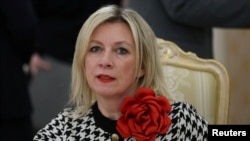
“It seems to me that all the published documents somewhat shatter the theses that official Yerevan has been trying to promote lately,” said Maria Zakharova, the Russian Foreign Ministry spokeswoman.
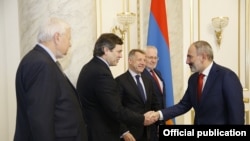
The Armenian government publicized those proposals, including a framework peace deal put forward by U.S., Russian and French mediators in 2019, on Tuesday after months of calls by the Armenian opposition holding Pashinian responsible for the 2020 war in Karabakh. The 2019 document was the last updated version of the so-called Madrid Principles that upheld the Karabakh Armenians’ right to self-determination while calling for their withdrawal from Azerbaijani districts around Karabakh occupied in the early 1990s.
Pashinian has repeatedly criticized the Madrid Principles since the 2020 war. In particular, he claimed in 2021 that the mediating powers sought a “surrender of lands” to Azerbaijan and offered the Armenian side nothing in return. A senior Russian diplomat, Igor Popov, bluntly denied this at the time. He argued that under the proposed settlement, Karabakh would have an internationally recognized interim status and retain control of two of those districts pending a future referendum on the region’s status.
The disclosed peace plan corroborates Popov’s assertion, a fact emphasized by Zakharova. She went on to blame Pashinian for the failure of joint U.S, Russian and French peace efforts.
“These documents were discussed during Armenian-Azerbaijani negotiations before the change of government in Yerevan in May 2018,” Zakharova told a news briefing in Moscow. “None of the parties rejected them, even though a full agreement was not reached. The main thing you will see is that negotiations were held on a regular basis up until 2018-2019 when Pashinian’s administration essentially interrupted the negotiating process and substantive dialogue instead of continuing it.”
The Russian official pointed to Pashinian’s famous 2019 statement that “Artsakh is Armenia, period!” made two months after the mediators formally submitted the peace plan to the conflicting parties.
“And we remember well what happened after that,” she said, referring to the 2020 war that paved the way for Azerbaijan’s full recapture of Karabakh in 2023.
Zakharova also said: “It follows from these documents that there were opportunities and they were missed. But it's not our fault. The natural question is who is to blame for that. Well, I suppose it’s not [a question] to us. Let the leaders of Armenia answer it for that country’s citizens.”
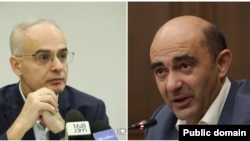
Pashinian is facing more such questions at home after publicizing the Karabakh peace proposals. Armenian opposition leaders continued to portray the documents on Thursday as further proof of their claims that he recklessly spurned a beneficial settlement and thus set the stage for the disastrous war.
“The guy … did everything to provoke the war,” charged Levon Zurabian of the Armenian National Congress, an opposition party led by former President Levon Ter-Petrosian.
Another opposition figure, Edmon Marukian, pointed out that Pashinian until recently denied the very existence of the 2019 plan.
Speaking in the Armenian parliament on Wednesday, Pashinian dismissed the plan as a mere “summary of the previous period of negotiations.” And he again claimed that it did not stipulate that Karabakh’s status should be determined only by its current and former residents. In fact, the document spoke of a “free expression of the will of Nagorno-Karabakh’s population” the results of which would be legally binding for all parties.