




The supposedly non-governmental delegation also met this week with a group of Armenian pundits during a visit to Yerevan organized by a local think-tank headed by Areg Kochinian, a pro-government analyst. The declared purpose of the visit was to advance the “peace agenda” of the Armenian and Azerbaijani governments.
Grigorian praised such contacts when he met on Wednesday with the participants of what his office described as “civil society representatives” from the two South Caucasus states. The official, who was born and raised in Karabakh, said they are part of the “process of normalization of Armenia-Azerbaijan relations.”
It emerged afterwards that the four Azerbaijani visitors included Dilara Efendiyeva, who was among government-linked protesters that blocked in December 2022 the sole road connecting Karabakh to Armenia on ostensibly environmental grounds. The blockade of the Lachin corridor, which caused severe food and medicine shortages in Karabakh, continued until Azerbaijan’s September 2023 military offensive that forced the region’s entire population to flee to Armenia.
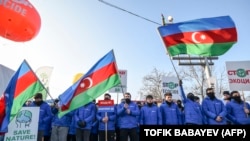
In her interviews with Azerbaijani state media, Efendiyeva repeatedly denied Baku’s responsibility for the exodus. She claimed that the Karabakh Armenians left their homeland because of being mislead by their leaders and that many of them are willing to live under Azerbaijani rule.
Two other members of the Azerbaijani delegation, Farhad Mammadov and Rusif Huseynov, made similar statements at the time. Mammadov described the Azerbaijani offensive as an “anti-terrorist operation” while Huseynov said the Lachin corridor is a “sword of Damocles” hanging over the Karabakh Armenians.
The Armenian authorities’ decision to not only let these individuals into the country but also have Grigorian meet with them caused an uproar on social media on Thursday, with many users expressing shock and indignation. Kochinian declined to comment on the criticism when contacted by RFE/RL’s Armenian Service.

“The Armenian authorities basically don’t give a damn about how the people of Artsakh feel about all this,” said Gegham Stepanian, Karabakh’s exiled human rights ombudsman. “I’m not just talking about this case.”
Prime Minister Nikol Pashinian, who is blamed by his political foes for the fall of Karabakh, has repeatedly made clear that the Karabakh issue is closed for his administration. He again said late last month that Yerevan will not press Baku to enable the Karabakh Armenians to return home.
Azerbaijani activists living in exile have also scoffed at the official description of Efendiyeva, Mammadov and Huseynov as civil society members. They said that President Ilham Aliyev’s authoritarian regime has practically eliminated civil society in Azerbaijan by imprisoning its members or forcing them to flee the country.